Effects of Remote Behavioral Skills Training on Caregivers of a Child with Autism Spectrum Disorder
DOI:
https://doi.org/10.18761/PACa098cdA23459Keywords:
behavioral skills training, remote training, caregiversAbstract
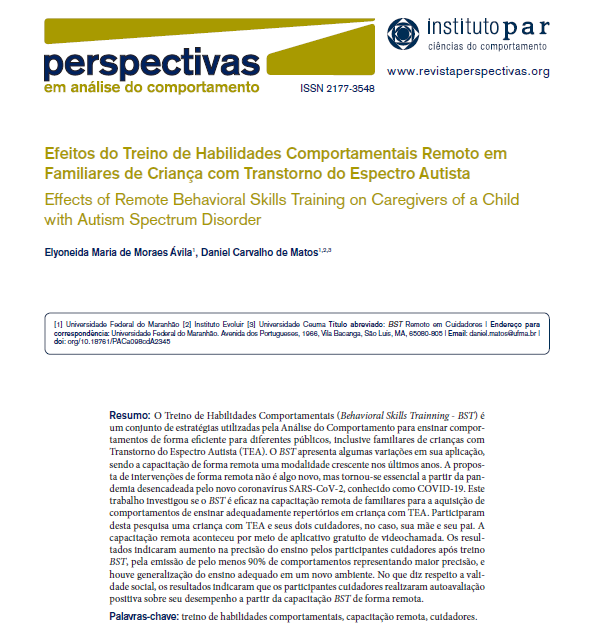
Behavioral Skills Training (BST) is a set of strategies used by Behavior Analysis to
teach behaviors efficiently to different audiences, including caregivers of children with Autism
Spectrum Disorder (ASD). The BST has some variations in its application, with remote training
being a growing modality in recent years. The proposal for interventions remotely is not
something new, but it has become essential since the pandemic triggered by the new coronavirus
SARS-CoV-2, known as COVID-19. This work investigated whether BST is effective in
remote training of caregivers to acquire behaviors to appropriately teach behavioral repertoires
in children with ASD. A child with ASD and his two caregivers, in this case, his mother and
father, participated in this research. The study took place remotely, through a free video call
application. The results indicated an increase in the teaching accuracy by the participating
caregivers after BST training, through the emission of at least 90% of behaviors representing
higher accuracy, and there was generalization of accurate teaching in a new environment.
About social validity, the results indicated that the caregiver participants performed a positive
self-assessment of their performance from the BST training remotely
Downloads
Downloads
Published
How to Cite
Issue
Section
License
A Perspectivas em Análise do Comportamento adota a licença Creative Commons Attribution-NonCommercial 4.0 International (CC BY-NC 4.0).
Os autores mantêm os direitos autorais de seus trabalhos e concedem à revista o direito de publicação.
Os artigos publicados podem ser compartilhados e adaptados, desde que:
- Seja atribuída a autoria e a fonte original
- Não haja uso para fins comerciais
Os autores estão autorizados a depositar e divulgar seus artigos em repositórios institucionais e plataformas acadêmicas.
A responsabilidade pelo conteúdo publicado é exclusivamente dos autores, incluindo a obtenção de permissões para uso de materiais de terceiros.
O uso de Inteligência Artificial (IA) deve ser devidamente declarado pelos autores e não configura autoria.
A revista opera em regime de acesso aberto, sem cobrança de taxas de submissão ou publicação.