On Brazilian translation of Science and Human Behavior
DOI:
https://doi.org/10.18761/shb047023Keywords:
Science and Human Behavior, translation, psychology system, teaching of Behavior AnalysisAbstract
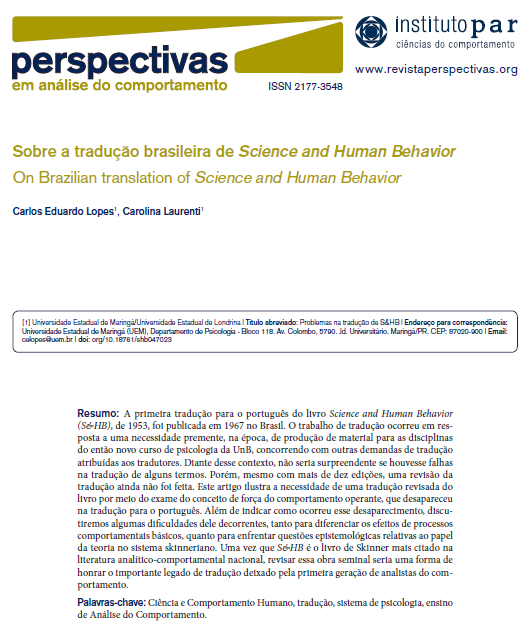
The first Portuguese translation of Science and Human Behavior (S&HB), from 1953,
was published in 1967 in Brazil. The translation work met a pressing need to provide textbooks
for the then-new psychology course at UnB, competing with other translation demands attributed
to translators. Given this context, it would not be surprising if there were errors in the
translation of some terms. However, even with more than ten editions, a translation review has
not yet been done. This article illustrates the need for a revised book translation by examining
the concept of strength of operant behavior, which disappeared in translation. In addition to
indicating how this disappearance occurred, we will discuss some difficulties arising from it,
both in differentiating the effects of basic behavioral processes and in facing epistemological
issues regarding the role of theory in the Skinnerian system. As S&HB is the most cited
Skinner’s book in Brazilian behavioral-analytic literature, reviewing this seminal work would
honor the valuable translation legacy left by the first generation of behavior analysts.
Downloads
Downloads
Published
How to Cite
Issue
Section
License
A Perspectivas em Análise do Comportamento adota a licença Creative Commons Attribution-NonCommercial 4.0 International (CC BY-NC 4.0).
Os autores mantêm os direitos autorais de seus trabalhos e concedem à revista o direito de publicação.
Os artigos publicados podem ser compartilhados e adaptados, desde que:
- Seja atribuída a autoria e a fonte original
- Não haja uso para fins comerciais
Os autores estão autorizados a depositar e divulgar seus artigos em repositórios institucionais e plataformas acadêmicas.
A responsabilidade pelo conteúdo publicado é exclusivamente dos autores, incluindo a obtenção de permissões para uso de materiais de terceiros.
O uso de Inteligência Artificial (IA) deve ser devidamente declarado pelos autores e não configura autoria.
A revista opera em regime de acesso aberto, sem cobrança de taxas de submissão ou publicação.