
Rule-governed behavior: an experimental study of augmenting rules
DOI:
https://doi.org/10.18761/PAC234ba6Keywords:
augmenting, function-altering effects, simple discrimination, simultaneous discriminationAbstract
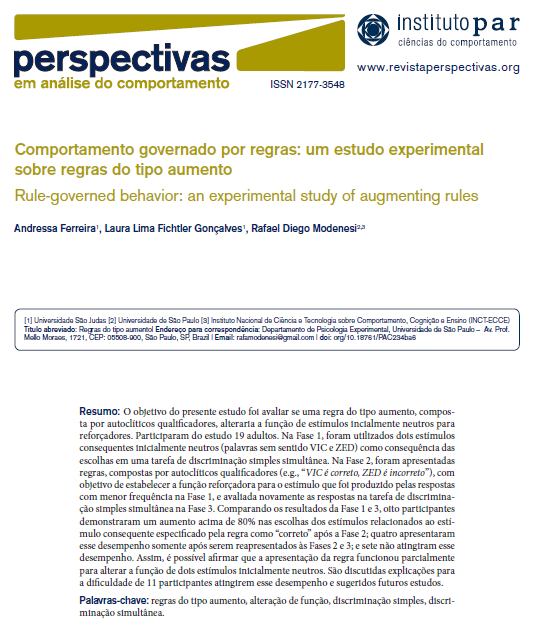
The aim of the present study was to assess whether a rule of the augmental type,
composed of qualifying autoclitics, would alter the function of initially neutral stimuli to
reinforcers. Nineteen adults participated in the study. In Phase 1, two initially neutral consequential
stimuli (meaningless words VIC and ZED) were used as consequences for choices
in a simultaneous simple discrimination task. In Phase 2, rules composed of qualifying autoclitics
(e.g., “VIC is correct, ZED is incorrect”) were presented with the aim of establishing a
reinforcing function for the stimulus that was produced by responses with lower frequency in
Phase 1, and responses in the simultaneous simple discrimination task were evaluated again
in Phase 3. Comparing the results of Phases 1 and 3, eight participants showed an increase
of over 80% in choices of stimuli related to the consequential stimulus specified by the rule
as “correct” after Phase 2; four exhibited this performance only after being reintroduced to
Phases 2 and 3, and seven did not achieve this performance. Thus, it is possible to assert
that the presentation of the rule partially worked to alter the function of two initially neutral
stimuli. Explanations for the difficulty of 11 participants in achieving this performance are
discussed, and suggestions for future studies are proposed.
Downloads
Downloads
Published
How to Cite
Issue
Section
License
A Perspectivas em Análise do Comportamento adota a licença Creative Commons Attribution-NonCommercial 4.0 International (CC BY-NC 4.0).
Os autores mantêm os direitos autorais de seus trabalhos e concedem à revista o direito de publicação.
Os artigos publicados podem ser compartilhados e adaptados, desde que:
- Seja atribuída a autoria e a fonte original
- Não haja uso para fins comerciais
Os autores estão autorizados a depositar e divulgar seus artigos em repositórios institucionais e plataformas acadêmicas.
A responsabilidade pelo conteúdo publicado é exclusivamente dos autores, incluindo a obtenção de permissões para uso de materiais de terceiros.
O uso de Inteligência Artificial (IA) deve ser devidamente declarado pelos autores e não configura autoria.
A revista opera em regime de acesso aberto, sem cobrança de taxas de submissão ou publicação.